 It's
probably
one
of the more cliche'd items about open-cockpit flying. You
tell folks you own an open-cockpit airplane, and they ask, "Do you
have a silk scarf?"
It's
probably
one
of the more cliche'd items about open-cockpit flying. You
tell folks you own an open-cockpit airplane, and they ask, "Do you
have a silk scarf?" It's
probably
one
of the more cliche'd items about open-cockpit flying. You
tell folks you own an open-cockpit airplane, and they ask, "Do you
have a silk scarf?"
Well...do you?
I'll admit, the outright classic nature of it is one big reason I wear one. But, you know, they're more than just a fashion accessory.
This was brought out to me just last spring. I'd brought my white silk scarf home to wash it, and had hung it on the shower rod to dry (high enough that the wife's cats can't reach it, thankyew very much).
The aforementioned wife happened to take a look at it. "Looks like it's time you bought another one," she said.
I hemmed and hawed. "Yeah, it's not really whitening up, but they're supposed to look a bit grimy..."
She shook her head. "No, this one is worn out. Look at the holes!"
Sure enough, she was right. After 20 years of use, I had a number of thin spots in my silk scarf, and a couple of spots where it had been worn right through.
Pure fashion sense didn't put so many flight hours on the scarf that I wore it out. Over the years, I have come to recognize it as a necessary item of my flight gear. Why?
One simple reason: The planes were wide-open, cold winds have a tendency to blow down the neck of pilots' coats. They had two basic choices: Wear a coat with a high, close-fitting collar, or use a bit of fabric to plug the gap...e.g., a scarf.
But there's a problem with that high-fitting collar. A tight collar restricts the motion of the neck...makes it harder to look around, to spot the wily Hun. What's more, wool, linen, cotton, or leather tends to chafe the tender skin around the neck.
So a scarf makes more sense. But a conventional woolen scarf isn't much of an advantage. The scarf needs to be a soft, yet tight-weave fabric that slips smoothly by the skin while still barring entry to the cold winds.
Nowadays there are probably dozens of miracle fabrics that fit the bill. But to the early aviator, there was only one: silk.
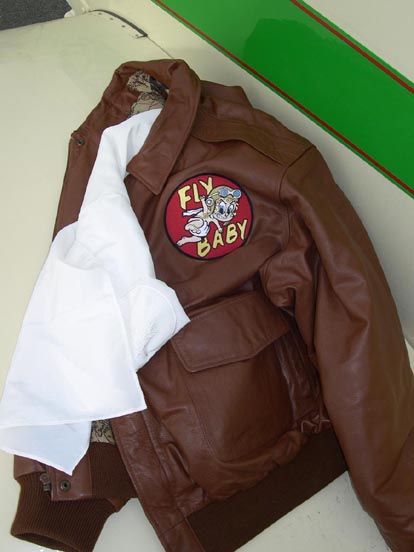
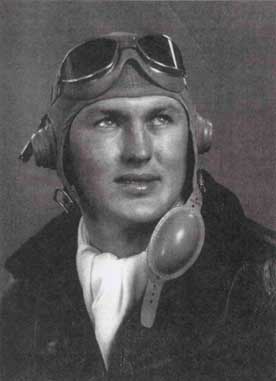
A silk scarf is a perfect companion to the traditional leather flying jacket. The inside of the jacket collar is usually a bit rough, but wrapping a scarf around your neck fixes that problem nicely.
I'm not sure where the tradition comes of a white scarf comes
in. It appears to be the color of the Army Air Force's
issues scarves during WWII, but it seemed to have been common
before that, too. It might be that the dyes of the day
tended to run and rub off against the clothing and skin, and
bleached white silk didn't have that problem. One person has
suggested that parachute silk was used, which wasn't dyed.
 It might, too, be related to the claim that
pilots used the scarves to clean the oil off their goggles while
flying. A white scarf would make sense, in that case, as you
could ensure that you used a clean spot on the scarf rather than a
part carrying dirt or oil.
It might, too, be related to the claim that
pilots used the scarves to clean the oil off their goggles while
flying. A white scarf would make sense, in that case, as you
could ensure that you used a clean spot on the scarf rather than a
part carrying dirt or oil.
However, I read one suggestion that really rings true: The
early aviators wore what were called opera scarves.
Imagine going out for a night of formal entertainment (such as an
opera) in 1910. You'll don "Evening Wear," which today we
might call "Black Tie" or a Tuxedo. Black pants, white
waistcoat, black coat with tails, white or black bow tie.
But it's a cold, rainy winter night, and the car/coach you'll be
riding to the event won't have a heater. So you'll put on a
top coat of the same quality and style as your evening wear, and
top it off with a fancy top hat.
But the topcoat doesn't button all they way to the top, so your
neck will get cold.
Hmmmm...what you need is a scarf. And since you're dressed
in white and black, the scarf better be white, too. The
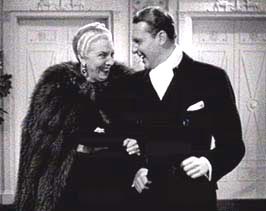
picture above shows Ralph Bellamy in the 1937 movie "The Awful
Truth," wearing an opera scarf that looks darn close to the
classic aviator scarf.
It really makes sense. Early aviation wasn't cheap, and a
number of the early aviators were affluent men who were accustomed
to formal wear, and would likely have owned a number of opera
scarves. Seems like it would be pretty natural to grab one
to go flying, if one's neck were getting cold or
chafed. And even the non-rich aviators would learn
that any men's clothing store sold "opera scarves" which were
perfect for flying.
The Spaulding company sold aviator's clothing in the post WW-I
period, Schiffer Publishing sells a reproduction
of the company's catalog. In it, you'll find leather
jackets, long leather coats, canvas one-piece flight suits,
leather helmets, gloves, goggles, boots, shoes, parachutes, even
waders.
But you don't see scarves. It might be that the price back
then was so low that it wasn't worth Spaulding's while to package
and ship them. Or... they knew it was something anyone could
buy at the local haberdashery.
 Color
Variations
Color
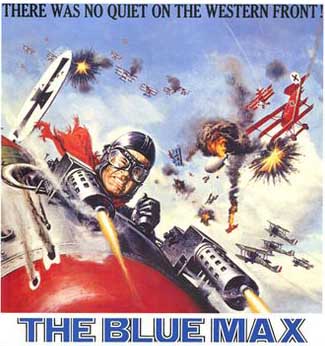
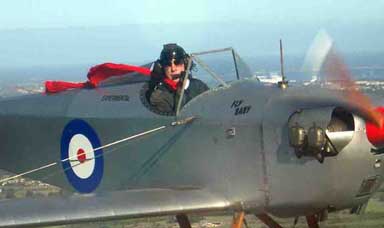
VariationsInterestingly, the poster for the movie shows Peppard with a RED scarf...and a frayed one at that!
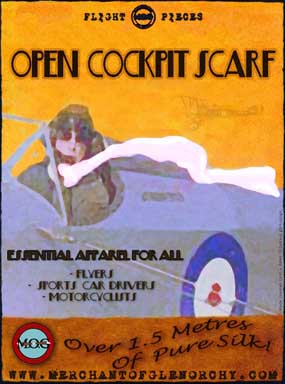
And it looks like Bob Grimstead keeps that red-scarf tradition with his "Bristol Balderdash" Fly Baby. Interestingly enough, when an aviation-collectables company named the Merchant of Glenorchy turned Bob's photo into an art deco poster (with Bob's permission), they turned the scarf white....pretty much reflecting the current style.
 Over
the
years, I've seen any number of colors, including some that were
printed in patterns. I watched the cringe-inducing movie, "A
Yank in the RAF" recently, and the title character (Tyrone Power)
wore some kind of weird paisley scarf. Logo scarves
seem big, now.
Over
the
years, I've seen any number of colors, including some that were
printed in patterns. I watched the cringe-inducing movie, "A
Yank in the RAF" recently, and the title character (Tyrone Power)
wore some kind of weird paisley scarf. Logo scarves
seem big, now.
Recently, I discovered a web page that mentioned that blue
scarves with small white polka dots were popular with RAF pilots
during WWII. Interesting enough news, but the page
then said that these scarves were still to be found in
western-wear stores! I found one displayed on the 'Wild
West
Mercantile' web page, and it was instantly
familiar. The big drawback is that the cowboy scarf is
a large square 35" per side... not suited to the really classic
look with the long tails hanging free. However, seems to me
that if you knot the scarf like a bandana and put the knot in the
BACK, it should look about right, if you're wearing a coat.
J. Peterman used to sell a replica RAF scarf. It was bit
pricy at $150, but they don't seem to carry it anymore. My
wife bought me one a few years back, and it's pretty nice.
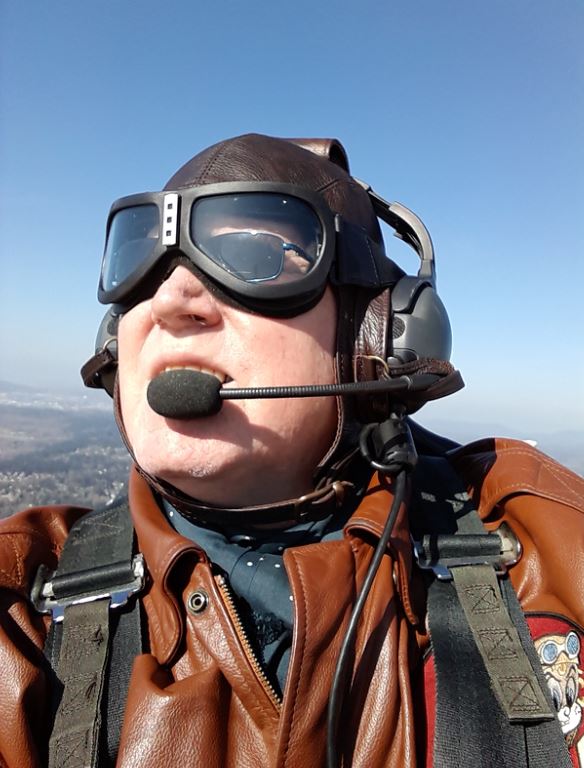
It's my main scarf now, when the weather turns colder. You
can see it in the picture below.
Basically, you want to buy a six-foot silk scarf.
Why six feet? Because you are going to tie it around your neck, and wrapping it around your neck and getting it secured will take a considerable length of that.
It's getting harder to find classic white aviator scarves. They're usually sold as novelty items...but the quality seems pretty good. Amazon has them for ~$20 to $40. The RAF style is available from several vendors, but I suspect the quality isn't the same as my $150 one.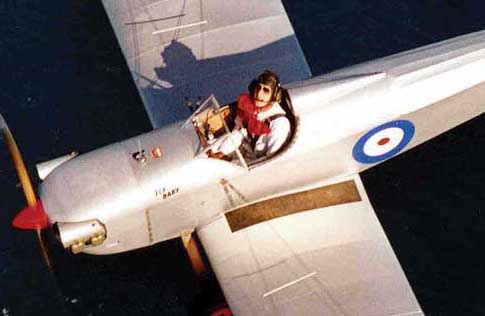 Wearing
the
Scarf
Wearing
the
ScarfOne big problem with that: Due to the slipstream being deflected by the windshield, the Fly Baby cockpit is a low pressure area. The wind hits the windshield and gets deflected upwards then rolls under. Thus, the usual airflow past the pilot's head is FORWARD. Back when I wore cotton balls as temporary ear plugs, they'd occasionally come free. I'd see them go forward, then up until they hit the main slipstream.
Your scarf will do the same thing, too, if you're not careful...as this picture of Bob Grimstead illustrates. Yes, the red thing in front of his chest is his scarf.
If you want the classic look of a scarf fluttering in the breeze, it's easy enough: Just buy a second scarf and attach it to the aircraft's headrest. That'll put most of its weight outside the turbulent area.
So, what do you do with the scarf that you're wearing?
There are two basic knots you can use. I use the classic square knot. I start with the scarf in front of my neck, take both ends completely around, then knot them in front and stuff the loose ends down under my shirt. The ends aren't very long, so even if they come loose, they don't usually cause a problem. Being so short, they can't really get grabbed that strong by the wind. I zip the jacket up almost all the way, too.
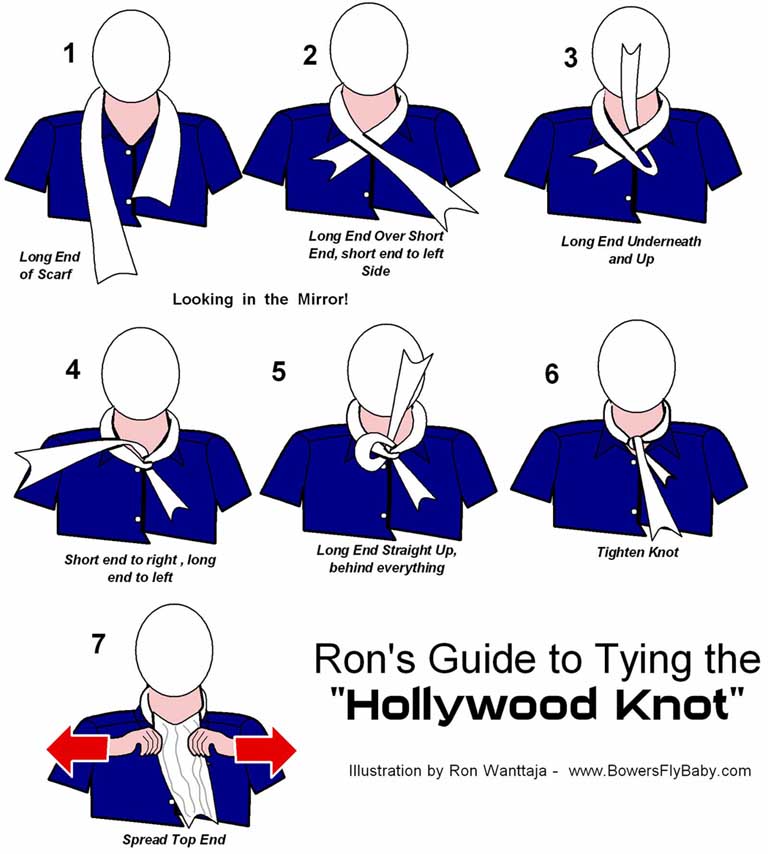
 The
second knot is something I call the "Hollywood Knot" It's
not really designed for open cockpits, but gives a devil-may-care
look under the leather jacket.
The
second knot is something I call the "Hollywood Knot" It's
not really designed for open cockpits, but gives a devil-may-care
look under the leather jacket.
The biggest problem with the Hollywood Knot is that the scarf ends are unsecured. Unless you make an effort to secure those ends, the scarf WILL billow in front of your face while you fly.
But, hey...it DOES look good, don't it?
The art of tying the Hollywood Knot has been lost for generations, but I think I have rediscovered it. It's basically a modified version of the standard double-Winsor knot, with the exception that the horizontal pass of the long end is left out.
Basically, you set up with one free end of the scarf very long, and the other very short. Cross the long end over the short end, bring it up the middle, take it to the side it originally came from, then back underneath again. Tighten the knot, then manually spread the top layer out.
I've added a visual guide to the end of this web page.
The top layer is essentially loose. If you put on a jacket, it will naturally form the billowy "V" shape around your neck. Without a jacket, the end hangs dashingly free.
 Wrapping Up (No pun intended)
If you wear any scarf while flying, though, make sure the ends are secure.
Finally, be advised: Hollywood Knot is a fearsome weapon, especially coupled with a dazzling smile. Use it responsibly.
One addition, suggested by a friend's talk with a WWII aviator: If your scarf is long enough, take a wrap completely around your neck before starting with Step 1. In other words, hold the middle of the scarf in front of your neck, then wrap both ends around until they come out as shown in Step 1.