






 |
 |
 |
 |
 |
 |
|
 |
 |
 |
 |
|

|
|
||||||||||||
|
|
||||||||||||
|
|||||||||||||
|
|||||||||||||
|
|||||||||||||
|
|||||||||||||
|
|||||||||||||
|
|||||||||||||
 PB100: Re-Booting the Fly Baby
This web page is for those interested in the Bowers Fly Baby homebuilt aircraft. This page is for information only, and is not affiliated with the owner of the rights to the Flybaby design.
Why a Fly Baby?
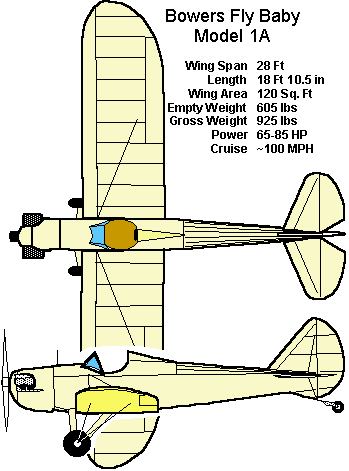
Description and Specifications
Wood and Welded Parts Suppliers
Some Real-World Performance Numbers
Engines
Cost Estimates
Results of the Builder Survey
Downloading the Free Plans
Why not build one of them, instead of a 40-year-old-design?
The answer lies in your own flying habits.
Why do you want an airplane? Will you be making regular trips for long distances? Carrying passengers? Blasting up to high altitudes?
Or are you just looking for a fun, knockaround airplane? Something that doesn't cost much to own? Something that you can go sightseeing in without breaking the bank on fuel costs. Something more substantial than an ultralight or ultralight-based design.
Take an honest look at the way you fly an airplane now. Do you just make "Hundred Dollar Hamburger" runs on the weekends? Do you fly just for the joy of flight? Do you generally go by yourself?
Then maybe...MAYBE...a Fly Baby might be the plane for you.
They're cheap as dirt to operate. Our EAA Chapter operated Pete
Bowers' prototype as a club airplane from 1987 to 1994. Rarely did
our yearly maintenance bill exceed $100. That's not a typo... One
Hundred Dollars. Even today, my airplane costs me,
generally, less than $500 a year in maintenance. Including
hiring an A&P for the yearly condition inspection.
The major drawback: Fly Babies don't come in kits. You carve every piece of wood; bend every bit of metal. Yet the Fly Baby is designed to be as simple as possible to build. EAA Judges rate aircraft at Fly-Ins, not only on how well the builder did, but on how difficult the airplane was to build. The Fly Baby has ALWAYS occupied the "easiest" category...even in today's modern kit era. They go together like a big balsa-wood model. You don't even have to build-up ribs like most wood homebuilts. Instead, you stack up sheets of plywood and "gang-saw" them all at once on a bandsaw.
By not buying a kit, you save tons of money. Even today, one can probably build a Fly Baby (less engine) for $6,000 or less. Even though it doesn't come as a kit, a lot of the major parts (fuel tanks, engine mounts) come from the J-3 Cub, and companies like Wag-Aero and Univair still sell these parts.
It's not "Tab A into Slot B" kitbuilding. But the Fly Baby was the seminal EAA project; it was the first (and so far, only) design ever to win an EAA design competition. EAA essentially cut its teeth on Fly Babies. If you need help building one, assistance is as close as your nearest EAA Technical Counselor.
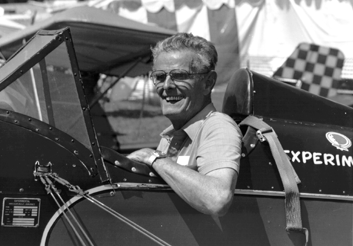
 While a single-seat airplane, the Fly
Baby isn't small. It has a wingspan just two feet less than a
Cessna 150. It's got a big cockpit. Pete Bowers is six feet two
inches tall, and I weigh about 250 pounds. That gives you an idea
of the range of sizes that can be accommodated.
While a single-seat airplane, the Fly
Baby isn't small. It has a wingspan just two feet less than a
Cessna 150. It's got a big cockpit. Pete Bowers is six feet two
inches tall, and I weigh about 250 pounds. That gives you an idea
of the range of sizes that can be accommodated.
The Fly Baby can be built as a biplane as well as a monoplane. The two monoplane wing panels are replaced by four smaller ones, plus a center section for the top wing. The aircraft can be switched back and forth between versions in about an hour, but it does take a helper. The biplane, while cool in concept, doesn't really offer too much. It's slower, and the wings don't fold. Still, its swept-back upper wings make it look a bit like a Bucker or Tiger Moth in the air, so if you'd really rather have a biplane, the Fly Baby would do the trick.
The monoplane/biplane issue is more than a wing swap...there are some internal braces and external tangs that have to be added to the fuselage. You can do this once the fuselage is done (The prototype was converted after completion), but it is, of course, easier during construction.
Switching back and forth between the wings takes two people about an hour. This assumes the rigging has already been set. While I helped on a wing swap, I never flew the biplane version. Other than appearances, there isn't much advantage. It's slower, and glides at an even steeper angle.
In monoplane or biplane configuration, the Fly Baby does meet the US rules for Sport Pilot. In the United States, you do not need an FAA medical to fly a Fly Baby.
With the plans off the market, building a biplane is
difficult. However, you might be able to buy a used set of
plans. In any case, my advice is to build a monoplane first,
to have something to fly, and build the biplane wings in your
spare time after the first flight. The biplane wings take longer
to build, since there are four panels and a center section, and
they're swept rather than straight. If you build the monoplane
wings first, you'll have something to fly while building the extra
wings.
Distance of ground run 265 feet/81 metres[RJW Note: This seems reasonable. A 2,000 foot runway is pretty much my threshold of "pucker factor". I've landed in shorter fields, but they take good concentration. If you've got unobstructed approaches, the 660-foot ground roll is definitely doable.]
lift off to 50' 450 feet/137 metres
total distance 715 feet/218 metres
add 30% safety factor = 925 feet/283 metres Take off Distance
Speed at 50ft 57 MPH/50 KIAS
50' to touchdown 640 feet/196 metres
ground roll 660 feet/201 metres (moderate braking)
add 30% safety factor = 1700 feet 516 metres recommended landing distance.
Suggested minimum runway distance for this aircraft:
1975 feet/600 metres.
Best rate of climb speed 57 MPH/50 knots IAS[RJW Note: The best rate speed seems a bit slow. I've been using 65 MPH for best rate, but haven't actually run a flight test on it. I like the extra speed buffer over stall.]
recommended 69 MPH/60 Knots IAS
Takeoff safety speed 63 MPH/55 Knots IAS
Maximum level speed 112 MPH/97 knots IAS[RJW Note: Don't forget, these figures are with a 100 HP engine!]
maximum climb rate 1300 ft per minute at 50 KIAS
normal climb rate 1000 ft per minute at 60 KIAS
On the subject of the Continentals, both 'Babies I've flown have been powered by the C-85. I've formated on A-65 powered versions. The performance difference was marked, especially considering I was heavier than the pilots flying the 65 HP versions. Tom Staples has replaced his A-65 with a C-85, and his daughter reports that his cruise went from 80 to 95 MPH and his rate of climb from 500 to 1000 FPM!
Volkswagens are too anemic. Draggy airplanes need large propellers, and your typical VW ends up with a little 42" toothpick to be able to turn the 3400 RPM where it produces 65 HP. VW-powered 'Babies have flown, but the owners soon convert them to Continentals.
An Rotax 912 (four cylinder four stroke) would be ideal, if you've got the $$$$$ to buy one.
Personally, I'm somewhat taken by some of the smaller auto-engine conversions. I've met the designer of the Stratus Subaru conversion a number of times, and think the engine has excellent possibilities as a Fly Baby powerplant.
An examination of Fly Baby engine options can be found on the Engines page.
When Pete Bowers passed away, he left his entire collection to
Seattle's Museum of Flight. It included a set of original
plans from 1965.
The Museum has scanned in the plans, and they are available for free download. You can read
them online, or click the "download" button. Be advised, the
file is over 100 megs in size, so it'll take a bit to download.
Old version of the plans? Not to worry...back in 2004,
Wolfgang Dertnig put together a list of plans
changes over the years.
Plus... The 1965 edition of the plans is almost identical to the EAA magazine articles, which means the PB100 material dove-tails in, nicely.
Those who like to get an idea of the total order size required can check out this attempt at a representative materials list. It's in Microsoft Excel format.
Aircraft Spruce and Specialty sells practically all the individual components, and Materials Kits to provide all the raw materials.
Wicks Aircraft is a
well-liked supplier of a wide variety of homebuilding
materials. They also have Materials
Kits.
Some Wood Sources:
Chesapeake Light Craft sells boat kits, but supposedly has some of the lowest wood prices aroundProbably the best source of Fly Baby goodies are unfinished projects and Fly Markets. There are still a number of unfinished projects out there...I once called on one that was essentially complete, less engine. The owner wanted only $1,000 for it.
Boulter Plywood is located near Boston, and is recommended by one of our New England builders.
This are of pretty good interest to Fly Baby builders. There are a number of hints and suggestions, and a total of 200 pages (printed double-sided, so there are only 100 sheets). Be advised there is an equal amount of "What Joe Smith is working on now" sort of information...vital and informative when the newsletter is mailed out, but of less use to builders thirty years later. It's fun to read, though.
Steve Pitts took the old Bulletins and converted them to Adobe
Acrobat format (.PDF). You can now download them for free.
Also, I've still got a few hard copies left, if you would
prefer. I'm selling these for $20, US Postage paid. Email me for ordering
information.
One of the main reasons the Fly Baby was so popular in the 1960s is its low-cost construction. Back then, aircraft-quality wood was still in wide production, and huge stocks of aircraft hardware (like turnbuckles) had been produced during the war and were still being sold at low prices.
Unfortunately, in the 45 years since, things have changed. It used to be that wood was cheap but alumimum was expensive; that's no longer the case. The surplus turnbuckles are long gone, and the new production stuff is quite a bit costlier.
In September, 2006, Dirk Chubbic of San Jose, California, took the bull by the horns:
"I got my Aircraft Spruce and Specialty catalogue recently and spent some time pricing FB construction. I started with the materials list from Ron's site and plugged in prices from AS&S, using the lowest prices when a choice was necessary (e.g. cad plated vs. stainless bolts).Since the Fly Baby is plans-built (e.g., no complete kit) the cost of construction varies from builder to builder. Some folks opt for all new hardware, some haunt the Fly Markets for good deals. As Dirk says, his pricing assumes new parts (albeit the lowest-cost new parts) exclusively. If you scrounge, or buy partially-completed aircraft, you can do a lot better."The total was about $8,125.
"Of course, that doesn't include engine, fuel tank/lines, prop, instruments, covering, paint or even glue. It's just the airframe and fittings. Of course, a good scrounge/bargan hunter can do it for less, but I think that's a good benchmark, just in case somebody asks."
The price can go higher, too.. If you decide to add stuff like an electrical system, radios, and a transponder, you'll add quite a bit to the cost of the airframe.
As far as engines go, check Trade-A-Plane for prices. A good C-85 will probably run ~$3,000-$4,000. A run-out will go for quite a bit less, and you can overhaul it yourself. A wood prop will run $600 or so.
Operating Costs
Fly Babies are very cheap to run. My C-85 burns ~5 gallons
an hour of $5.00/gallon car gas. That's $25 an hour, plus a bit
more for oil. Hangar costs vary widely, but you can probably get
your Fly Baby under cover for ~$300 or less per month. Don't
tie the plane outside for long periods--it isn't good for it.
Liability insurance (only) costs about $300/year.
Aerobatics
Accidents:
Detailed Report: N2695Avionics (See Also Electronics)
Detailed Report: N96MG
Detailed Report: N101LX
NTSB Summaries
Panel-Mounting a Handheld RadioBiplanes:
Antennas for Fly Babies
Wind-Powered Generators
Ron's Avionics Box
Building an Adaptor to Use a Commercial Headset with an Aircraft Radio
Converting a Russian Helmet - Part 1 and Part 2
Instrument Panel Pictures
Homemade Under-Helmet Headset
Improving the volume level when using a handheld radio with aviation headsets
- The above link has a lot of background on how my headset evolved. If you *just* want to read how to build one, never mind all the side routes, check the Condensed Version.
Installing BNC connectors on antenna cables.
ADS-B and the Fly Baby
Converting a C85-12 from the Delco generator and regulator to a B&C alternator.
Aerobatics and the Fly Baby: An EditorialCalendar
All Those Wires! A look at alternative wing-bracing schemes
Overall Discussion
A Look at Wing-Failure Accidents:
A Wing-Folding Guide
A strut-braced Fly Baby, courtesy of Miguel Tschopp's web page. This airplane was built in Argentina, and Miguel's web page includes the official drawings needed for approval by the local FAA-equivalent.
Split-Axle Landing Gear
Cantilever wings (eliminating the bracing wires)
A Guide to Open-Cockpit ComfortElectronics/Avionics
Ear Protection
Original Seat Write-Up
More on Seats
Warmth and general comfort
Eric Whittred's Seat Design
Fly Babies for the Big and Tall
The Webmaster's New Clothes
The Belly Inspection Panel
Scarves
Goggles
How to Add a Canopy
Converting a surplus Russian flying helmet to Fly Baby use
Follow-Up: Adding IPOD ear buds to the Russian helmetElevator Trim
How to add a baggage compartment
A Skosh More Room. A simple modification that gives you another inch of legroom.
Trim Systems:
Do-It-Yourself Ejection Seat
Leather Jackets for the Open-Cockpit Aviator
Modifying the cockpit coaming for more room.
Building an under-helmet headset.
All about Leather Helmets
Battery installationEngines:
Panel-mounting a Handheld Radio
Ron's avionics box
Wind Generators
Surviving Without an Electrical System
A low-cost radio antenna
Instrument Panel Pictures
Installing an Electronic Tachometer
Rebulding a Fly Baby Electrical System
Including lots of good information for those working from scratchInstalling BNC Connectors
Building an under-helmet headset.
Improving the volume level when using a handheld radio with aviation headsets
The Engines PageFlight Simulator
Engine Options
Maintenance Problem Reports
Survey Results on Engine Selections
Harry Fenton on Engines
Starter Clutch Problems
Remote-Release Tail Hooks as a Hand-Propping Aid
Battery selection and location
Trouble-shooting electrical system problems
Adding an auxiliary fuel Tank
Adding a starter to an A65
Fly Baby Model for Microsoft Flight SimulatorFlying Advice/Reports:
Fly Baby Model for Vehicle Simulator
A Radio-Controlled Fly Baby for $40
Aerobatics and the Fly Baby: An EditorialFolding Wings
Flying Advice (General)
Nouvelle Classique (pilot report by webmaster)
Punkin (Biplane pilot report by Chris Eulberg)
Jerry David's account of the first flight of his OWN Fly Baby Bipe
Chuck Davis' report of his first flight in the Fly Baby he bought.
V-Speeds.
Preflight/Pretakeoff Checklists
The Fly Baby and Sport Pilot
Fly Baby Bulletin downloads. Pilot reports, builder reports, etc. from the 1960s.
A Wing-Folding GuideFor Sale
Aircraft and ComponentsInstruments
T-Shirts and other Gear
Pre-Buy Inspections for Used Fly Babies
How the landing gear is part of the wing bracing systemLight Sport Aircraft
How about tri-cycle gear?
Rolling your own Goodyear brake pads
Tailpost Problems and their Correction.
A discussion on split axles.
Drew Fidoe on care and feeding of Maule SFSA tailwheels.
Rotating Tires
Split-Axle Landing Gear
What Size Tires for a Fly Baby?
Replacing Goodyear Wheels with Grove Wheels
The Fly Baby and Sport PilotMagazine Articles
BibliographyMicrosoft
Nouvelle Classique (KITPLANES pilot report by webmaster)
Fly Baby Bulletin downloads. Pilot reports, builder reports, etc. from the 1960s.
Fly Baby Model for Microsoft Flight SimulatorPatches
Ordering Jacket PatchesPainting
Painting a Fly Baby with Latex house paintPeople
Drew's Ten-Year UpdateThree-View Drawing for working on paint schemes (works better if you right-click and save to your own disk)
Getting the WWII Army Air Force markings right.
Francis Londo built one of the first customer Fly Babies.Poetry
Jim Wilson was just 17 when he flew his Fly Baby from Idaho to Alaska
Dale Weir, as a teenager, was Pete Bowers' photographer for many of the classic air-to-air shots of the first Fly Baby
Drew Fidoe discusses how he took his Fly Baby from hangar-crushed wreck to a replica British fighter
Back in 1973, Bob Carlisle decided to set some international records in his Fly Baby
And of course Peter M. Bowers
A Poem for Old Tail Dragger Pilots, by Wendell DavenportPictures
He Wanted to Fly, by Robert Gellock
Dale Weir's Collection. A great sampling of early Fly Baby photos.Pilot Reports
Index to Fly Baby Photo Albums
"Altered States" - Doctored photos
Arlington 40th Anniversary Event
Flabob 40th Anniversary Event
Videos
Fly Baby-related Artwork
Three-View Drawing
Insrument Panels
Fly Baby Persona for Firefox
Not photos, but sketches of a Fly Baby under construction
Slightly Weird Pictures. Like "Altered States", but not edited.
Fly Baby Memes
Aviation Artist Bob Parks drew this fantastic, large illustration of an RC Fly Baby.
List of Pilot ReportsParts:
A Record-Breaking Fly Baby
Pilot Operations Handbook (POH). That's a Word version so you can edit it and insert your own values. Here's a PDF for those who just want to look at it.
Fly Baby vs. Pietenpol
Building a Fly Baby using the free EAA Magazine ArticlesPlans
Commercial Suppliers
Making your own Goodyear brake pads
Cheap 'n Easy Gap Seals
Materials List
List of Plan Revisions
Seattle's Museum of Flight has the 1965 version of the plans available for free download.Propellers:
List of Plan Revisions
The PB100 Companion Guides dovetail nicely with the Museum of Flight's free download
Survey Results on Propeller SelectionsRebuilding a Fly Baby
Propeller Selection: That Ol' Black Magic
This Old Plane - Drew Fidoe's rebuilding notesSafety
Aerobatics and the Fly Baby: An EditorialSimulator
Condition Inspection Checklist
The Safety Page
Fly Baby Weight and Balance Spreadsheet
Pilot Operations Handbook (POH). That's a Word version so you can edit it and insert your own values. Here's a PDF for those who just want to look at it.
Heat-Induced control jamming.
The Pete Bowers Heresy
Third-party reports regarding Fly Baby structural safety
Re-rigging the flying wires
Fly Baby model for Microsoft Flight SimulatorSport Pilot
Fly Baby Model for Vehicle Simulator
The Fly Baby and Sport PilotStories
The Stories PageStructural Issues
The Bracing PageSuppliers
English translation of Finnish Load-Test Report
Third-party analysis in 2022
Commercial VendorsTailwheels
Materials List (Excel Spreadsheet)
Drew Fidoe on the care and feeding of the Maule Tailwheel. PDF File.Technical Issues
Tail Post Repair
Tailwheel Springs
The Advice Page (for folks new to the Fly Baby world)Tires, Wheels, and Axles (See also "Tailwheels")
Tech Talk (more in-depth technical material)
List of Plans Revisions
The Fly Baby and Sport Pilot
This Old Plane - Drew Fidoe's Restoration Notes
Fly Baby Bulletin downloads. Pilot reports, builder reports, etc. from the 1960s.
Adding elevator trim
Adding an auxiliary fuel Tank
Fly Baby rigging and trim
Cantilever Wings
Tire Rotation on Fly BabiesTransport
Split Axles
Tailwheel Springs
Tire and Wheel Selection for Fly Babies
Replacing Goodyear Wheels
Trailer required for carrying a Fly BabyTrim and Rigging:
In-Flight Videos with external camerasWebinar:
Links to Youtube and other videos
Ron's Fly Baby history presentation, videoed by EAA Chapter 818
Design Weight (See the text on the figure)Windshields
Survey Results on Empty Weights
Typical weight of individual components
Plexiglas or Lexan? One-Piece or Three-Piece?Wood
How to Add A Canopy
Wood Selection and Testing (PDF file)
Wood Suppliers
Wood Construction Links
Robert "Veeduber" Hoover's Blog
19 October 2023
Goodness, gracious, where does the time go. Someone pointed
out I hadn't updated the page for nearly an entire year! In
the last year, I've given over a dozen presentations on several
subjects (including the Fly Baby, of course!) and haven't really
wanted to face my computer sometimes.
EAA Chapter 818 actually videoed my Fly Baby presentation, and
it's online!
Biggest news is the addition of the Dale Weir photo collection.
Dale, as a 14-year-old, was handed Pete's camera and plopped into
the back seat of a J-3 to photograph Pete in the Fly Baby
prototype in flight. Some fantastic pictures came out of
that, not just of the Fly Baby on the ground. I'm tickled
pink Dale let me scan in these photos...some of them we've seen
before, but never in this level of sharpness and detail.
Ten new stories!
Also, I added a new Index section for stories about other Fly Baby owners.
10 November 2022
My policy is to disseminate any safety information about Fly
Babies, good or bad. A long-time member of the Fly Baby
community sent me this
report covering his concerns about the wing bracing.
Yeah! The 2023 Fly Baby calendar
is out.
Speaking of wing bracing, I replaced
my flying wires this summer.
I had the carb heat control knob drop on on my airplane. See how I fixed it.
10 February 2022
Yeee-HAW! When Pete Bowers passed away, he left his entire
collection to Seattle's Museum of Flight. It included a set
of original plans from 1965. The Museum has scanned in the
plans, and they are available for free
download. You can read them online, or click the
"download" button. Be advised, the file is over 100 megs in
size, so it'll take a bit to download.
Old version of the plans? Not to worry...back in 2004,
Wolfgang Dertnig put together a list of plans changes over the years.
Plus... The 1965 edition of the plans is almost identical to the
EAA magazine articles, which means the PB100
material dove-tails in, nicely.
Between the Museum of Flight's file, and the PB100 material,
builders will have all the information they need.
For free.
Needless to say, the Fly Baby community is ecstatic over
this.....
7 December 2021
Starting out with a great picture of Ian Cameron's Fly
Baby. The shot was taken by his friend, Don Lewis.
The 2022 Calendar is up!
I've been remiss in adding picture of newly-completed Fly Babies
and a few of older airplanes that have turned up. They're on
the 12th sheet of the Photo Section.
Three new stories! A nice fall flight to a local
landmark, a short treatise on paying
attention, and a little bit about the Fly Baby's black sheep relative.
And... a bit more information on seats.
28 September 2021
Added a great pilot report
by Iain MacDonald.
26 September 2021
Leadoff photo is an atmospheric winter shot from Hans Teijgeler.
I was shocked to discover that I hadn't added pictures of Jim Katz's newly-completed Fly
Baby to the web page.
This should serve as a reminder to both y'all and me: I
want to include EVERYONE'S Fly Baby on the pictures pages.
If your plane isn't there, send me some good photos and I'll add
them. Even if it's a Fly Baby you used to own, I'll add it.
Four stories added,
as well.
10 May 2021
With the pandemic, some folks were concerned that I hadn't
updated the page for a while. All's well here; it's just
that with the reduction in travel, me and the Fly Baby aren't
getting out to new places and new adventures.
A couple of things folks might find interesting:
The leadoff picture is NOT a Fly Baby; it's Pete's other design,
the two-seat "Namu II." I've
done some research and collected as much information as I
can. No, I haven't found any plans for it. Don't ask.
Over the years, I've struggled with my Fly Baby's Delco generator
and regulator. I finally got fed up, and replaced it with a
B&C alternator and voltage
controller. Went pretty smooth, with just a few
glitches.
Also, whether or not a post a notice here, I do update the Fly Baby calendar every year. I
do notify the folks on the mailing list and the Facebook page.
12 August 2020
The airplane on the front this time is Jim Katz's N502F...which,
as you can see, has a paint job identical to that of the original
prototype.
Still in the midst of the Covid-19 pandemic. Fly Baby
owners are prepared, though....

Biggest news this time is that a man in British Columbia is
offering add-on starter kits
for A65s. Price for a ready-to-bolt-on unit is about $1100
US.
Bunch of new stories,
too.
13 January 2020
Added a write-up on the legal issues and options regarding ADS-B Out in a Fly Baby.
16 December 2019
The Yahoo Groups function has been pared way back, so we've changed the email list to Groups.io.
12 November 2019
The Fly Baby is the famous winner of the 1962 EAA contest, but is
it the Pretender to the Throne?
I've written a lot about how to stay warm while flying a Fly
Baby, now here's the ultimate Guide
to Open Cockpit Comfort.
I pick up some Remedial
Education.
A guy wanted to know just how to build a low-profile headset like
I use on my Fly Baby, but the original write-up had a lot of
extranous material. I put together a Condensed Version to make it
easier.
The belly panel makes it easy to access the bottom of the cockpit
from under the airplane, but it makes maintenance
access easier from above, as well.
Weird noises in any vehicle, airplane, car, whater, bug the heck
out of me. Ban the Bonk is
about chasing down one such.....
PB100 is essentially complete.
I've got Guides written for the first 11 of 14 EAA articles.
The last two are on fabric covering, and the other is on
assembly. The EAA magazine article covers assembly pretty
well, and the covering information is pretty much out of
date. I may try to put something together on these in the
future, but it won't be soon.
Back in the '60s, aviation artist Bob Parks worked with Pete
Bowers at Boeing. Parks did a great large-scale drawing of a
Radio Controlled Fly Baby.
The 2020 Calendar is out!